


Journal
What is the difference between cinnamon and cassia? | Two barks, told apart by the cut end

Cinnamon and cassia are both spices made by drying the bark of trees in the laurel family. They are, however, different trees. Ceylon cinnamon (Cinnamomum verum), and cassia (Cinnamomum cassia). Much of what is sold as cinnamon in Japan is in fact cassia.
In short: the same word, two different trees
Cinnamon comes from Sri Lanka. Only the inner bark of young shoots is used. Cassia comes from southern China, and here the thick bark is used as it is.
Under Japanese labelling rules, both may be written as cinnamon. The name will not tell you which you have. To tell them apart, look at the thing itself.
The way to tell: the cut end of the stick
Ceylon cinnamon is many sheets of thinly peeled inner bark, layered and rolled together. The cut end spirals, the quill is slender, the colour is pale. Press it and it crumbles. The finer, paler and more fragile it is, the higher it is regarded.
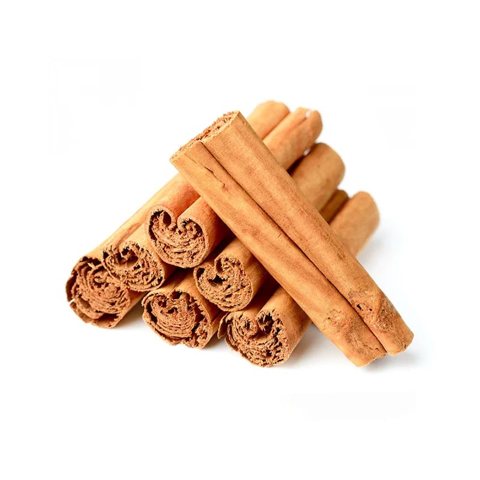
Cassia is a single sheet of thick bark, hard and curled. The cut end is one tube. The colour is dark, and a household mill will get nowhere with it. If you buy it whole, choose it on the understanding that it goes into the pot whole, not crushed.
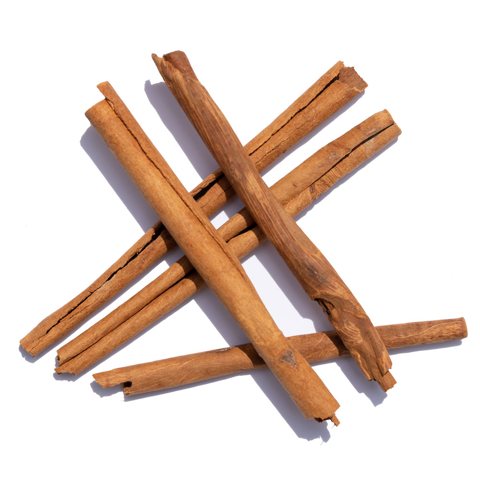
Slender, fragile, many layers: cinnamon. Thick, hard, one layer: cassia.
The difference in aroma is a difference in thickness
Cinnamon is light, with a citrus-like freshness out in front. Cassia is dark and straight. The sweetness and the warmth are strong, and a prickling sharpness and an astringency ride on top of them. The freshness cinnamon carries is not there in cassia.
Cassia holds one aroma compound that cinnamon does not: coumarin, the same powdery sweetness found in tonka beans and in the salted cherry leaf of sakura-mochi. That is why the sweetness of cassia reads as deeper than cinnamon's.
One more thing. Cinnamon smells sweet, yet it is not sweet on the tongue. There is no sweetening compound in it. It still reads as sweet because the aroma calls up the memory of sweetness. That gives you a way to strengthen sweetness without adding sugar.
Which to use depends on what it goes into
Apples, baked goods, compotes. Cinnamon suits anything whose own aroma is delicate. For drinks that are brewed out, for anything combined with milk, it is cassia. The reason is density. In something as dense as milk, the delicacy of cinnamon is buried. The thickness of cassia is not.
When to add it differs too. The main aroma compound of cinnamon does not dissolve in water. Oil, alcohol and steam carry it. That is why brewing it in water alone leaves the aroma flat. On toast with butter; worked into a dough and baked. That is where it shows what it can do. Too much heat brings out bitterness, so to make the most of the sweet aroma, add it late.
How Inspice chooses between them
In the Inspice spice encyclopedia, cinnamon and cassia stand as separate entries. They are not gathered under one word because they are used as separate materials.
Cassia is the foundation of every chai in the range. It is also in Spice Curry Symphony No.1 to No.4, in Dish No.2 and No.3, in HOT SPICE Shibikara and in the cocoa. It is one of the materials that appears most often at Inspice. What a chai brewed in milk needs is not delicacy but presence.
Cinnamon, on the other hand, appears in exactly one blend: FlareLine MELLOW FIRE. It builds a sweet bridge to the toasted note of cacao nibs, and the heat of habanero closes the phrase. That bridge is given to the lighter of the two barks. Cassia here would make the bridge too thick.
The other mix-up: Indian bay leaf and laurel
The confusion that happens with bark happens with leaves as well. The leaf called bay leaf in Indian cooking is the leaf of a cassia tree (Cinnamomum tamala). It is a different tree from laurel (Laurus nobilis).
Here too you can tell by looking. Indian bay leaf has three veins running straight down the length of the leaf. Laurel spreads its veins like a feather.
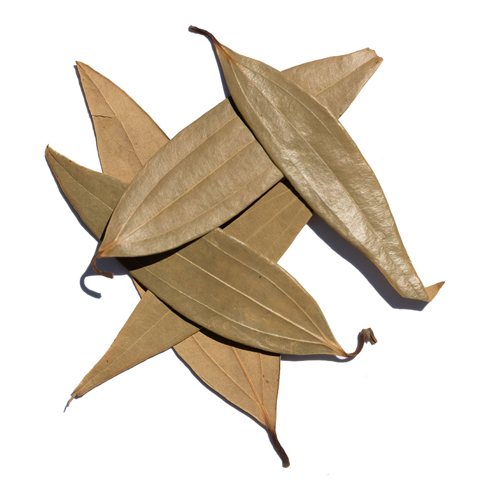
Their aromas are opposites. Indian bay leaf is sweet and warm; laurel is resinous and cooling. Spice Curry Symphony No.3 deliberately holds both, as two separate materials in one blend. Two leaves of different character, a sweet one and a clean one, holding up the simmer between them.
The full breakdown of each aroma is gathered on the pages for cinnamon, cassia and Indian bay leaf.
Frequently asked questions
Q. Is the cinnamon in the supermarket cinnamon or cassia?
A. Most often it is cassia. Under Japanese labelling rules both may be written as cinnamon, so the name will not tell you. With sticks you can tell from the cut end. Slender, pale and rolled in many layers is Ceylon cinnamon. Thick, hard and a single curled sheet is cassia.
Q. Can cinnamon and cassia be substituted for each other?
A. They can, but the result changes. Cassia in baked goods or with apples brings out a strong sweetness and sharpness that covers the aroma of the fruit. Cinnamon in a drink brewed with milk is buried by the milk. Cinnamon for the delicate, cassia for the dense: that is the guide.
Q. Are Indian bay leaf and laurel the same thing?
A. They are not. Indian bay leaf is the leaf of a cassia tree; laurel is the leaf of the bay laurel. Three veins running straight down the length means Indian bay leaf; veins spreading like a feather means laurel. The aromas differ as well: Indian bay leaf is sweet and warm, laurel is resinous and cooling. Swapping one for the other changes the direction of the whole pot.


